Everything Baked Salmon
Crispy everything-bagel crusted salmon baked at 400°F with a Dijon-maple glaze. Quick, customizable, with tips for timing and doneness.
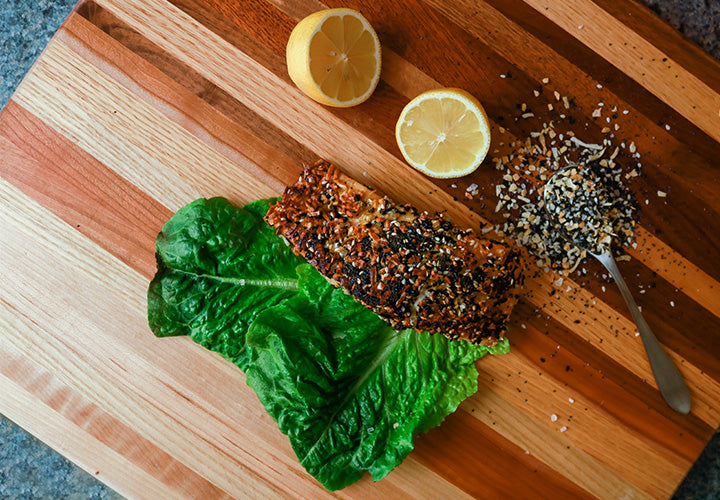
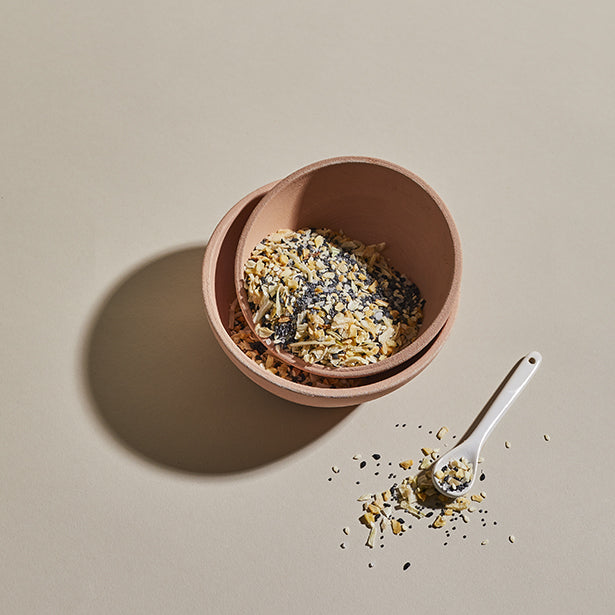
Everything bagels and lox are a classic pairing, so we went a step further with Everything Bagel Seasoning and a fresh salmon filet. This encrusting technique is an excellent way to cook salmon and can be modified easily. Try swapping the bagel seasoning for seasoned panko bread crumbs or chopped almond slivers.
Submitted by: Geoff Marshall M from Chicago, IL
Yield: 2 servings
- Brush salmon with a Dijon-maple glaze, press on everything bagel seasoning, sear 1-2 minutes, then bake at 400°F for 8-10 minutes.
- Pat fish dry and bring to room temperature 30-60 minutes before cooking for even doneness and a crisper crust.
- You can swap the bagel seasoning for panko, nuts, or breadcrumbs; target 145°F internal temperature or remove at 140°F and rest to finish.
Spices
Featured in this Recipe

Preparation Instructions:

thespicehouse.com
More About This Recipe
Frequently Asked Questions
What oven temperature and timing should I use?
Preheat the oven to 400 degrees F. After searing the seasoned side 1 to 2 minutes in a hot, oiled oven-safe pan, bake the salmon for about 8 to 10 minutes. Check for an internal temperature of 145 degrees F or remove at 140 degrees F and let rest 3 to 5 minutes for carryover cooking.
How do I get a crisp, golden everything-bagel crust?
Pat the salmon dry and press the mustard-maple glaze on so the seasoning sticks. Use a hot pan with a thin coat of oil and sear the seasoned side without moving it for 1 to 2 minutes until golden. Finish in the oven to cook through without burning the crust.
Can I use frozen salmon for this recipe?
Thaw frozen salmon fully in the refrigerator before cooking. Pat it very dry and bring it to room temperature 30 to 60 minutes before cooking. Cooking from frozen will change sear and bake times and can lead to uneven doneness.
What can I substitute for everything bagel seasoning?
Use seasoned panko, chopped almonds, chopped pistachios, or plain breadcrumbs mixed with salt, pepper, and herbs. Tightly press any substitute onto the glazed flesh so it forms a firm crust during searing.
Should I cook skin-on or skinless salmon?
Both work. If your fillet has skin, leave it on. After encrusting the flesh side and quickly searing that side, flip the fish so it goes into the oven skin-side down. This helps protect the flesh and gives crisp skin.
How can I tell when the salmon is done without a thermometer?
Check for flakiness: the flesh should flake easily with a fork but still look a bit translucent in the center. A visual guide is a change from translucent to opaque and an easy separation of flakes. For best accuracy, use an instant-read thermometer and target 145 degrees F.
Any tips to avoid burning the seasoning when searing?
Use medium-high heat, not full blast, and a pan with a little high-smoke-point oil. Sear only 1 to 2 minutes and watch closely. If the seasoning is browning too fast, lower the heat slightly before finishing in the oven.
Can I prepare this ahead of time?
You can make the mustard-maple glaze and measure the seasoning in advance. Coat the fish and press on the seasoning up to a few hours before cooking, but for the crispiest result, coat right before searing. Refrigerate assembled fillets for up to 24 hours if needed.
What oven temperature and timing should I use?
Preheat the oven to 400 degrees F. After searing the seasoned side 1 to 2 minutes in a hot, oiled oven-safe pan, bake the salmon for about 8 to 10 minutes. Check for an internal temperature of 145 degrees F or remove at 140 degrees F and let rest 3 to 5 minutes for carryover cooking.
How do I get a crisp, golden everything-bagel crust?
Pat the salmon dry and press the mustard-maple glaze on so the seasoning sticks. Use a hot pan with a thin coat of oil and sear the seasoned side without moving it for 1 to 2 minutes until golden. Finish in the oven to cook through without burning the crust.
Can I use frozen salmon for this recipe?
Thaw frozen salmon fully in the refrigerator before cooking. Pat it very dry and bring it to room temperature 30 to 60 minutes before cooking. Cooking from frozen will change sear and bake times and can lead to uneven doneness.
What can I substitute for everything bagel seasoning?
Use seasoned panko, chopped almonds, chopped pistachios, or plain breadcrumbs mixed with salt, pepper, and herbs. Tightly press any substitute onto the glazed flesh so it forms a firm crust during searing.
Should I cook skin-on or skinless salmon?
Both work. If your fillet has skin, leave it on. After encrusting the flesh side and quickly searing that side, flip the fish so it goes into the oven skin-side down. This helps protect the flesh and gives crisp skin.
How can I tell when the salmon is done without a thermometer?
Check for flakiness: the flesh should flake easily with a fork but still look a bit translucent in the center. A visual guide is a change from translucent to opaque and an easy separation of flakes. For best accuracy, use an instant-read thermometer and target 145 degrees F.
Any tips to avoid burning the seasoning when searing?
Use medium-high heat, not full blast, and a pan with a little high-smoke-point oil. Sear only 1 to 2 minutes and watch closely. If the seasoning is browning too fast, lower the heat slightly before finishing in the oven.
Can I prepare this ahead of time?
You can make the mustard-maple glaze and measure the seasoning in advance. Coat the fish and press on the seasoning up to a few hours before cooking, but for the crispiest result, coat right before searing. Refrigerate assembled fillets for up to 24 hours if needed.
Excellent recipie
Only change I made was to use maple syrup with bourbon