07.10.2018
Rare Hawaiian Sea Salt—Then and Now
Discover Molokai black sea salt: solar-evaporated, charcoal-fused, mineral-rich finishing salt for fish, steak and desserts.
- Molokai black sea salt is solar-evaporated and fused with food-grade activated charcoal to create large, mineral-rich crystals ideal for finishing dishes.
- Its composition is about 84% sodium chloride and 16% trace minerals, giving it an intense, bright saltiness and unique black color.
- Production supports Molokai's local economy and is overseen by the Salt Masters Guild of Hawaii, with producers like Cameron Hiro at Psalty Farms.
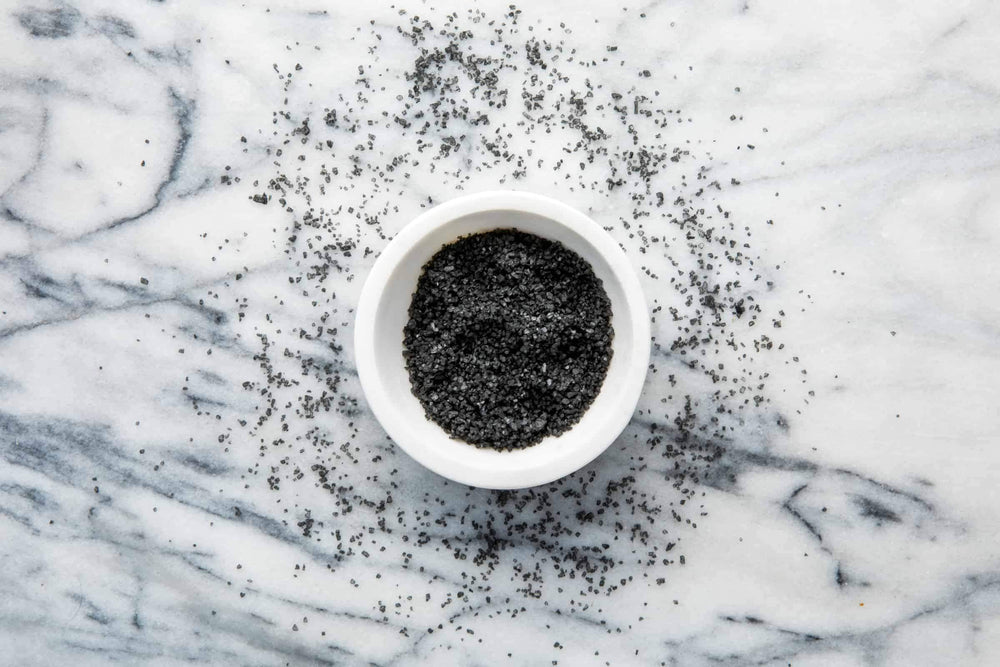

In the days of global seafaring, salt was crucial to warding off malnutrition while aboard ship. Today sea salt is crucial to warding off boring food. Hawaiian Black Salt is perfect for that. Our Hawaiian salt comes from the island of Molokai, which is one of the least developed of the Hawaiian islands. This means their waters are some of the cleanest in the archipelago. The final product of evaporated salt is fused with the highest purity and quality activated charcoal, then dried inside of a custom designed solar evaporator. The food grade solar pans are hermetically sealed to allow slow evaporation, which leaves the large salt crystals intact. This also retains all the valuable trace minerals and electrolytes. Most sea salt contains about 95% sodium chloride and 5% trace minerals, but this black salt yields a content breakdown of about 84% sodium chloride, with 16% trace minerals.
 In the 1700’s, the British navigator James Cook made several voyages through the Pacific Islands and visited Hawaii three times. His sailors collected black salt from the shoreline at low tide. James Cook was known to have the healthiest crew among the British navy. He hardly lost a man to the dreaded scurvy. This was in part because of the salt, but also because he required his crew to eat sauerkraut and malt, a byproduct of the beer making process. Their health was positively affected by the outstanding mineral content of the salt found among the rocks of Hawaii.
The resurgence of salt harvesting on Molokai has brought new life to the economy of the island. Hawaiian sea salt is bottled and labeled under the supervision of the Salt Masters Guild of Hawaii. Cameron Hiro is one of those Salt Masters. He's been producing high quality salt for over 14 years, and produces this black salt on his property named Psalty Farms.

Pictured left to right: Jacque (mom), Houston (son), and Cameron (dad).[/caption] This salt presents itself on the tongue as very bright with an intense saltiness, which we surmise comes from the abundance of trace minerals. It is ideal for finishing dishes, as the salt's special color and texture will be lost in sauces and soups. Try a little over some fresh cooked fish or steak. Black salt has become popular amongst bakers and dessert fanatics too. Cookies and caramels are excellent with a little sprinkle of black salt, as well as a simple loaf of bread. Not too long ago this special salt was available only to local Hawaiians. We are delighted to share it with you thanks to the Hiros and their neighbors on Molokai. Aloha!
Article by Tom Erd, Spice House Owner
Frequently Asked Questions
What is Hawaiian black sea salt?
It is sea salt harvested on Molokai and finished with food-grade activated charcoal. The salt is slow-evaporated in sealed solar pans to form large, mineral-rich crystals with a distinctive black color.
Why is the salt black?
The black color comes from high-purity activated charcoal fused into the evaporated salt. The charcoal adds color and a mild mineral note but does not make the salt unsafe to eat.
How is this salt made differently from regular sea salt?
Producers use hermetically sealed solar evaporator pans for slow evaporation so crystals stay large and trace minerals remain. After evaporation the salt is blended with activated charcoal to create the black variety.
How does its mineral content compare to ordinary sea salt?
Most sea salts are about 95% sodium chloride with 5% trace minerals. Molokai black salt is roughly 84% sodium chloride and 16% trace minerals, so you get a higher mineral share and a stronger flavor.
How should I use Hawaiian black salt in cooking?
Use it as a finishing salt so the color and crunchy texture stay visible. Sprinkle it on cooked fish, steak, breads, cookies, caramels, or salads. Avoid using it in long-simmered sauces where its visual appeal disappears.
Is this salt healthier or lower in sodium?
It contains slightly less sodium by percentage than typical sea salt, but it is still mostly sodium chloride. It can add perceived saltiness so you may use less, but it should be used in moderation like any salt.
Is it safe for people on medication?
The product uses food-grade activated charcoal, which is safe for most people. However activated charcoal can affect how some medications are absorbed. If you take prescription drugs, check with your healthcare provider before using it regularly.
How do I tell if the salt is authentic Molokai black salt?
Look for origin labeling showing Molokai, production under the Salt Masters Guild of Hawaii, or producer names like Cameron Hiro of Psalty Farms. Authentic producers often note solar evaporation and small-batch processing.
What is Hawaiian black sea salt?
It is sea salt harvested on Molokai and finished with food-grade activated charcoal. The salt is slow-evaporated in sealed solar pans to form large, mineral-rich crystals with a distinctive black color.
Why is the salt black?
The black color comes from high-purity activated charcoal fused into the evaporated salt. The charcoal adds color and a mild mineral note but does not make the salt unsafe to eat.
How is this salt made differently from regular sea salt?
Producers use hermetically sealed solar evaporator pans for slow evaporation so crystals stay large and trace minerals remain. After evaporation the salt is blended with activated charcoal to create the black variety.
How does its mineral content compare to ordinary sea salt?
Most sea salts are about 95% sodium chloride with 5% trace minerals. Molokai black salt is roughly 84% sodium chloride and 16% trace minerals, so you get a higher mineral share and a stronger flavor.
How should I use Hawaiian black salt in cooking?
Use it as a finishing salt so the color and crunchy texture stay visible. Sprinkle it on cooked fish, steak, breads, cookies, caramels, or salads. Avoid using it in long-simmered sauces where its visual appeal disappears.
Is this salt healthier or lower in sodium?
It contains slightly less sodium by percentage than typical sea salt, but it is still mostly sodium chloride. It can add perceived saltiness so you may use less, but it should be used in moderation like any salt.
Is it safe for people on medication?
The product uses food-grade activated charcoal, which is safe for most people. However activated charcoal can affect how some medications are absorbed. If you take prescription drugs, check with your healthcare provider before using it regularly.
How do I tell if the salt is authentic Molokai black salt?
Look for origin labeling showing Molokai, production under the Salt Masters Guild of Hawaii, or producer names like Cameron Hiro of Psalty Farms. Authentic producers often note solar evaporation and small-batch processing.
Rare Hawaiian Black Lava Sea Salt
I am interested in the salty flavor and lower percent of Sodium Chloride of this salt. Do the other Hawaiian sea salts have these characteristics? Is there a white-colored salt with these characteristics? Does lower Sodium Chloride mean Lower Sodium?
Thank you,
J L
Reading about black lava & red sea salt was very informative & interesting to know. I was born & raised in Lahaina but have lived in North Carolina for fifty years. I’m planning to come home & one thing for certain, I’ll have to try, then purchase black lava salt to bring back with me to NC. for my family here. I’ve used red salt before, so ono. Mahalo for this article. It’s good to know.